New Research Published
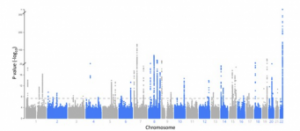
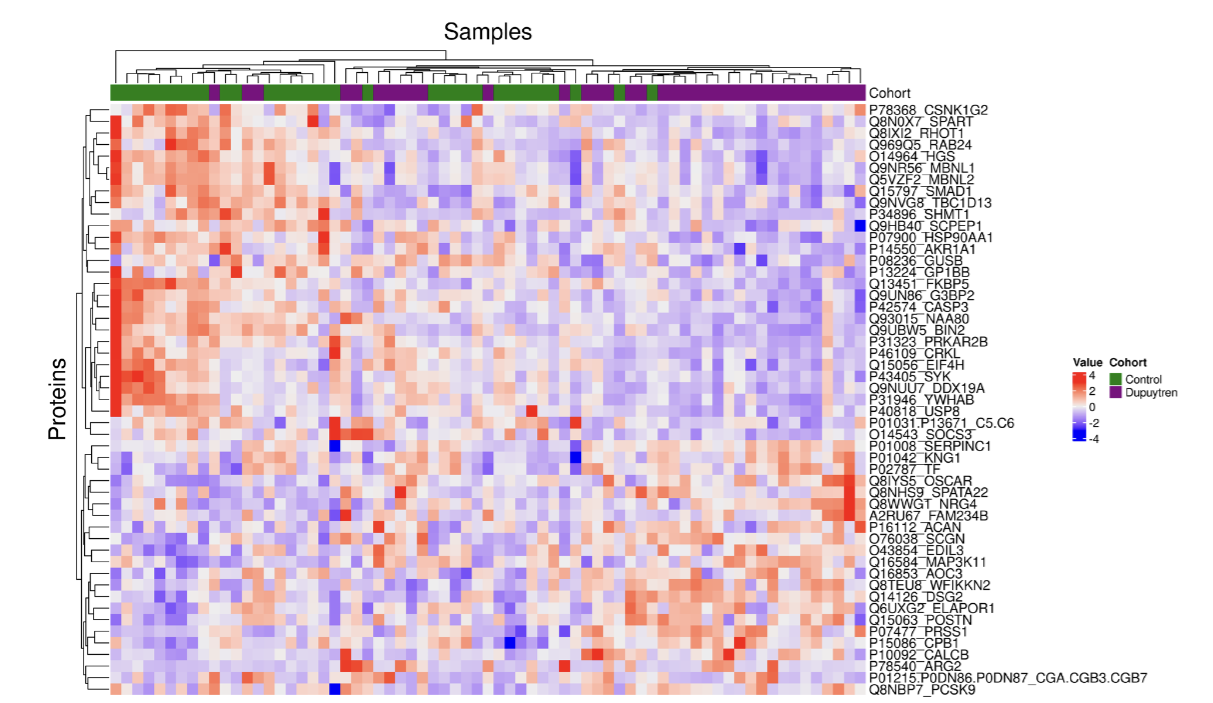
The Dupuytren’s Research Group has recently published the results of a preliminary investigation into predictive biomarkers relevant to the treatment and management of Dupuytren’s contracture. The version of the paper currently available is what is known as a preprint and has yet to be peer reviewed. There may be some minor changes to come as reviewers never (in my experience anyway) accept everything. I’m giving my personal comments below and the picture at the top of the page is copied from the paper. There is also an easy to follow introduction to the research from Charles Eaton in the form of a YouTube video at https://www.youtube.com/watch?v=LKcl3SdhhpQ. For anyone wanting to read the details the paper can be found at doi: https://doi.org/10.1101/2024.12.13.628406.
Why do we need this research?
Unlike many medical conditions there are no diagnostic test for Dupuytren’s other than measuring finger angles once the condition is already apparent. In particular there are no methods of assessing the early stages of Dupuytrens before the fingers are already in the contracted position. There are a growing number of treatments that could be used early in development if the condition could be identified. Further, knowing more about an individual’s case could lead to personalised treatment. This approach is being used successfully for other conditions, why not Dupuytren’s.
Why are pharmaceutical companies not doing the research?
Despite being very common, with a similar incidence to that of colon cancer for example, Dupuytren’s is not seen as a target condition by pharmaceutical companies, probably because it is not life threatening andsurgical treatment is generally successful . The risk to potential reward doesn’t doesn’t stack up for most. One biotech company that did do a clinical trial was 180 Life Sciences Corp (180 LS). Unfortunately the FDA (US Food and Drug Administration) rejected the proposal to use data from a Phase 2b study to support an application for approval to repurpose adalimumab to treat Dupuytren’s Contracture. 180 LS now seems to have given up on being a biotech to focus on Etherium, a cryptocurrency, and has rebranded as ETHZilla!
Dupuytren Research Group study.
The study started back in 2020, just in time to be disrupted by the covid pandemic. Instead of recruiting 100 subjects for the clinical trial only 45 were eventually signed up; 25 with Dupuytrens and 20 non-Dupuytren’s as a control group for comparison. The tudy cost around $500,000 with funding coming as a grant from the US National Institute of Health (NIH) and further support from the National Databank for Rheumatic diseases. Despite the relstively small size of the study, a huge amount of data has been generated. Knowing how much research can cost, the funding has been well spent as far as I can see.
Approach to biomarker development
There are two basic ways of looking for biomarkers for a particular disease. The first is based around current knowledge with the assumption that you know roughly what you are looking for (hypothesis-based). A key focus for this approach was the various forms of collagen, but an additional 328 proteins were also included based on previously published research. The second approach is to look at as many potential markers as possible (hypothesis-free). In theory there are at least 20,000 different proteins in the human body that could be assessed! In this study the researchers included around 7,000, so not everything but a pretty good sample.
Key findings.
A really important point has to be evidence pointing to the lack of collagen degredation as opposed to collagen enhanced collagen synthesis as being the underlying cause of contracture. Treatment could therefore be focused on enhancing degredation rather than blocking synthesis.
Potential approaches to developing biomarker tests, know as Diagnostic Proteomic Risk Scores (DPRS), were developed from the both the hypothesis -based and hypothesis-free methods. However, these results are preliminary and their accuracy is lower than desired at 76.5% and 70.6%. Still this is better than the accuracy of PSA testing for prostate cancer and that has been used for many years on millions of men!
Where next
So there is a lot of potential to build on, which is what good science should do. The groupis planning a much larger study both in terms of participants and the number of proteins to examine (11,000). The big issue is going to be cost, with an estimated budget of $5 million. This sounds like a big number but actually equates to 50 cents for each of the 10 million US Dupuytren’s patient, or a little less than £2 for each Dupuytren’s patient in the UK!
Sadly, I don’t think the NIH will be contributing as their budgets have been cut by the current US administration. So how to get hold of the money is going to be the big challenge facing the group.
Anyone know a billionaire with crooked fingers?